



Medical cryolipolysis in Naples to reduce localised fat resistant to diet and physical activity, with a non-surgical, controlled treatment and no significant recovery times.
Cryolipolysis at Centro Medico Gargano in Naples is a non-surgical medical-aesthetic treatment indicated for reducing localised fat deposits on the abdomen, flanks, thighs, arms and other selected body areas.
What is Cryolipolysis?
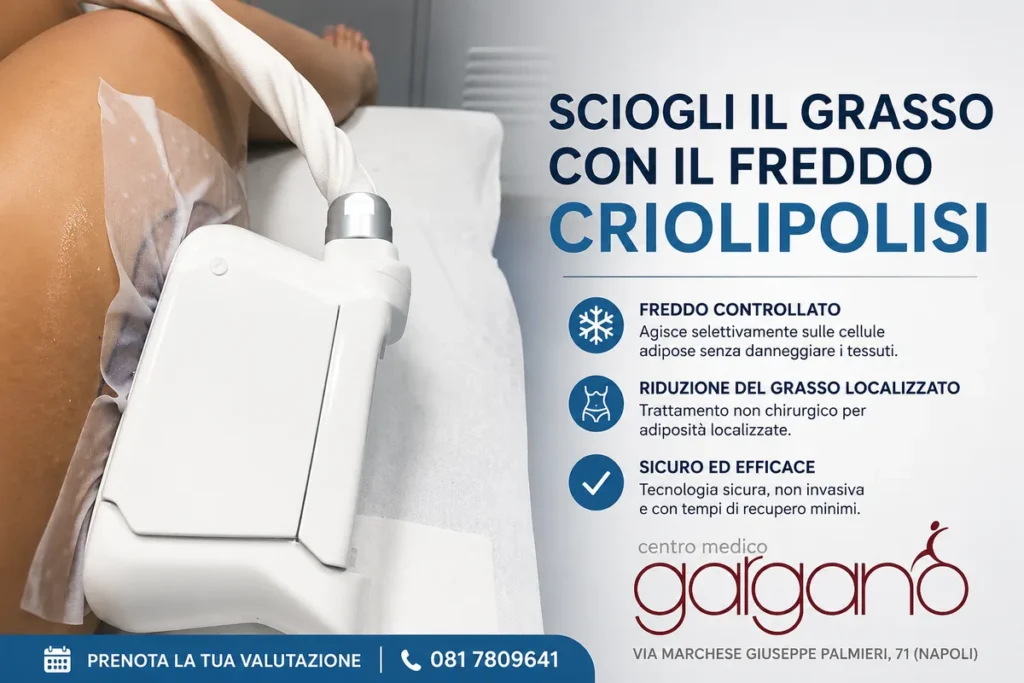
Cryolipolysis is a non-surgical method that uses controlled cooling to act on subcutaneous fat tissue.
Fat cells are sensitive to low temperatures. During the treatment, the selected area is cooled in a controlled manner using a specific applicator. This process can promote a progressive reduction of the treated fat cells, which are then gradually eliminated by the body through normal metabolic mechanisms.
The result is not immediate. Improvement tends to appear progressively in the following weeks, with greater definition of the treated area over time.
Cryolipolysis for abdomen, flanks, thighs and arms in Naples
Cryolipolysis can be used to treat various body areas, when localised fat is well-defined and the patient has suitable characteristics for the treatment.
The most frequently treated areas are:
Abdomen
Indicated in cases of localised fat deposits in the abdominal region, especially when the patient has stable and well-assessable subcutaneous fat accumulation.
Flanks
Cryolipolysis of the flanks can be useful for improving the lateral body profile and reducing so-called lateral fat accumulations.
Thighs and ‘culotte de cheval’
In some cases, it may be indicated for localised fat deposits in the trochanteric region or on the outer part of the thighs.
Arms
It can be considered in patients with localised fat accumulations in the upper arm region, always after medical assessment of skin quality.
Lumbar region
It can be used to treat localised accumulations in the lower back, if appropriate indications are present.
When is cryolipolysis indicated?
Cryolipolysis is primarily indicated for patients with localised fat resistant to diet and physical activity, but who do not need or do not wish for surgical treatment.
It can be considered when the following are present:
- well-defined localised fat deposits;
- relatively stable weight;
- skin with good elasticity;
- realistic expectations;
- absence of specific contraindications;
- desire for a non-surgical treatment with no long recovery times.
Correct indication is fundamental. Not all fat deposits are the same, and not all patients respond in the same way. For this reason, at Centro Medico Gargano, cryolipolysis is only offered after a medical assessment.
Cryolipolysis: when it’s not the right treatment
Cryolipolysis is not indicated for general weight loss, obesity, or significant reductions in body weight.
It should not be considered an alternative to liposuction in cases where large quantities of adipose tissue need to be removed. Furthermore, in the presence of significant skin laxity, marked cellulite, oedema, lipoedema, or vascular alterations, it may be necessary to opt for a different or integrated approach.
During the consultation, it is assessed whether the main problem is truly adipose or if different components are present, such as fluid retention, oedema, lymphatic alterations, venous insufficiency, or tissue laxity.
This aspect is particularly important because what the patient perceives as “fat” is not always solely adipose tissue.
Medical assessment before cryolipolysis
Before undergoing a cryolipolysis session in Naples at Centro Medico Gargano, an assessment of the area to be treated is carried out.
The consultation allows for the analysis of:
- localisation of the fat deposit;
- thickness of the fat layer;
- quality and elasticity of the skin;
- possible presence of oedema or fluid retention;
- vascular and lymphatic conditions;
- patient expectations;
- any contraindications.
The objective is to determine whether cryolipolysis is truly useful or if other aesthetic medicine treatments or a different clinical pathway are more indicated.
How a cryolipolysis session is performed
During the session, an applicator is applied to the area to be treated, which cools the fat tissue in a controlled manner.
The patient may initially feel an intense cold sensation, traction, tension, or slight local discomfort. These sensations generally tend to decrease during the treatment.
The duration of the session varies depending on the area treated and the established protocol. Afterwards, the patient can usually resume normal daily activities, unless otherwise medically advised.
In the following days, redness, slight swelling, tingling, skin sensitivity, or small bruises may appear. These are usually transient effects.
Cryolipolysis abdomen: images before, during and immediately after the session
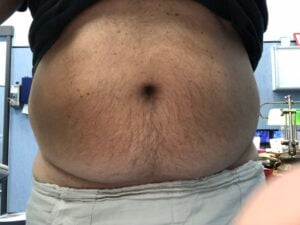
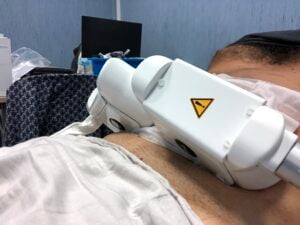
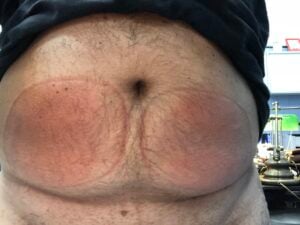
Abdominal cryolipolysis is a non-surgical treatment indicated for localised fat deposits resistant to diet and physical activity.
The images show the three main phases of the procedure: the initial assessment of the area to be treated, the application of the applicators, and the appearance of the skin immediately after approximately 50 minutes of treatment.
The redness visible at the end of the session is a transient local reaction related to the action of controlled cooling and suction exerted by the applicator.
The reduction of the fat layer is not immediate, but occurs progressively in the following weeks, with variable results depending on the patient’s individual response.
For this reason, at Centro Medico Gargano, cryolipolysis is always preceded by a medical assessment, useful for determining if the treatment is indicated, which areas to treat, and what realistic results to expect.
How long does it take to see cryolipolysis results?
The results of cryolipolysis are not immediate.
The body progressively eliminates the treated fat cells in the weeks following the session. Generally, the first changes can be observed after a few weeks, while the definition of the treated area tends to become gradual over time.
The response varies from patient to patient and depends on several factors, including:
- treated area;
- thickness of the fat tissue;
- individual metabolism;
- lifestyle;
- weight stability;
- number of sessions performed.
To maintain and enhance the result, it is important to follow a correct lifestyle, with a balanced diet and regular physical activity.
How many cryolipolysis sessions are needed?
The number of sessions required depends on the area to be treated, the extent of the localised fat deposits, and the objective agreed upon during the medical assessment.
In some cases, a single session on a specific area may be sufficient. In other cases, it may be indicated to schedule multiple sessions or combine cryolipolysis with other aesthetic medicine treatments, always based on the patient’s clinical picture.
Personalising the protocol is essential to avoid unnecessary treatments and to set realistic expectations.
Cryolipolysis and safety
Cryolipolysis is a non-surgical treatment, but it must be performed with correct indications and appropriate protocols.
An accurate medical assessment helps reduce the risk of inappropriate treatments and identify any conditions that might make the procedure unsuitable.
At Centro Medico Gargano, the approach to cryolipolysis is based on three elements:
medical assessment, to understand if the patient is a candidate for the treatment;
personalisation, to realistically choose areas and protocol;
safety, to avoid unnecessary or unsuitable treatments.
Cryolipolysis or liposuction: what’s the difference?
Cryolipolysis and liposuction are not the same thing.
The cryolipolysis is a non-surgical treatment, indicated for selected localised fat deposits of limited or moderate extent.
The liposuction is instead a surgical procedure that allows for a more significant removal of adipose tissue, but requires different indications, preparation, anaesthesia and recovery times.
For more limited localised fat deposits, intralipotherapy, an injectable method that represents a different approach compared to both cryolipolysis and liposuction, may also be considered. The choice is made after medical assessment based on the location, thickness of the fat layer, and patient characteristics.
During the medical assessment, it is possible to understand which approach is most consistent with the patient’s situation, avoiding unrealistic expectations.
Cryolipolysis in Naples at Centro Medico Gargano
The Centro Medico Gargano in Naples offers cryolipolysis as a medical-aesthetic treatment for selected localised fat deposits.
The goal is not to promise rapid weight loss or standardised results, but to assess the individual patient and propose a treatment consistent with their clinical picture.
Cryolipolysis can be a useful solution for improving body contour in specific areas, when localised fat is well-defined and the patient is correctly selected.
To find out if cryolipolysis is indicated in your case, it is advisable to book a medical assessment.
Why the cryolipolysis I use is different
At Centro Medico Gargano, I use advanced cryolipolysis technology, designed to act on localised fat deposits in a controlled, safe, and selective manner.
It’s not simply about “cooling the fat”, but combining multiple control and tissue stimulation systems, with the aim of making the treatment more effective, more comfortable, and safer for the patient.
Constant temperature control
The applicator is equipped with a temperature monitoring system in contact with the plate, which allows for dynamic control of cooling during the session.
This allows for maintaining a stable and controlled temperature, up to approximately -10°C, preserving the safety of the procedure and optimising treatment effectiveness.
CoolFrequency® Technology
The technology CoolFrequency® uses modulated low-frequency pulses that generate micro-contractions in the tissue without producing heat.
This stimulation is regulated according to the patient’s tolerance and helps improve comfort during the session, contributing to skin relaxation and better management of the treated tissue.
Vacupulse® System
The system Vacupulse® uses active and continuous suction, maintaining correct contact between the tissue and the applicator plates.
This aspect is fundamental because it helps preserve local microcirculation and reduce the risk of uneven superficial cooling, which can occur with less advanced technologies.
TissueActive® Mode
The mode TissueActive® combines the action of Vacupulse® and CoolFrequency®, with the aim of preserving skin vascularisation during treatment.
This combination allows for more complete and controlled treatment of localised fat deposits, with a procedure that is generally well-tolerated and compatible with a rapid return to normal daily activities.
What are the benefits for the patient?
Thanks to this technology, cryolipolysis can offer several advantages:
- non-surgical treatment of localised fat deposits;
- absence of anaesthesia;
- no incisions and no scars;
- immediate return to normal activities;
- possibility of treating multiple areas in the same session, when indicated;
- high temperature control throughout the procedure;
- greater comfort compared to traditional technologies.
In selected patients, the treatment can contribute to a progressive reduction of the localised fat layer, visible in the weeks following the session.
Book an assessment for cryolipolysis in Naples
If you wish to reduce localised fat on the abdomen, flanks, thighs, arms or other areas resistant to diet and physical activity, you can book a medical assessment to understand if cryolipolysis in Naples is the most suitable treatment for your case.
Book a consultation at Centro Medico Gargano.
Centro Medico Gargano – Naples
Telephone: 081 7809641
WhatsApp studio: 348 7035744
Cryolipolysis is not a general weight loss treatment, but a method indicated for localised fat deposits. For this reason, a preliminary medical assessment is fundamental, useful for determining if the treatment is truly indicated and which areas to treat.
FAQ
Does cryolipolysis make you lose weight?
No. Cryolipolysis is not a weight loss treatment, but a method to reduce localised fat deposits in specific body areas. It is indicated when weight is relatively stable and fat is localised.
Is cryolipolysis painful?
During the session, intense cold, traction, or local tension may be felt. These sensations generally tend to decrease during the treatment.
How long does it take to see results?
Results appear gradually. The first changes can be observed after a few weeks, while the definition of the treated area may continue in the following months.
How many sessions are needed?
It depends on the area treated, the thickness of the fat layer, and the patient’s objective. The number of sessions is determined after medical assessment.
Does cryolipolysis replace liposuction?
No. Cryolipolysis is a non-surgical treatment for selected localised fat deposits. Liposuction is a surgical procedure with different indications.
Can I have cryolipolysis on my abdomen and flanks?
Yes, the abdomen and flanks are among the most frequently treated areas, but a medical assessment is necessary to understand if the adipose tissue and skin are suitable for the treatment.
