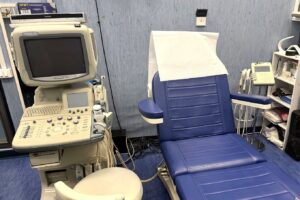

Venous Doppler ultrasound at Centro Medico Gargano in Naples is a non-invasive specialist examination used to assess venous circulation in the legs, the saphenous veins, venous reflux, varicose veins, swollen legs and suspected venous insufficiency or thrombosis.
Booking and price
Lower-limb venous colour Doppler ultrasound
Service price: see the booking calendar
Time allocated for the appointment: 60 minutes
Phlebology consultation included.
When is venous colour duplex ultrasound useful?
A non-invasive specialist examination to assess venous circulation in the legs, the saphenous veins, venous reflux, varicose veins and the deep venous system. It is also indicated for swollen legs, heaviness, pain or suspected venous insufficiency.
Protected online booking
Encrypted HTTPS connection. Card details are not stored on our website, and payment is handled securely by the payment platform.
What is venous colour duplex ultrasound used for?
Venous colour duplex ultrasound of the legs examines blood flow in the deep and superficial veins, assessing any reflux, vein enlargement, valve incompetence or circulatory abnormalities.
The examination also helps distinguish a predominantly venous problem from other possible causes of swelling, pain or heavy legs, and is an essential step before planning many phlebological treatments.
Quick facts
- Non-invasive examination with no radiation
- Assessment of the deep and superficial venous systems
- Evaluation of the saphenous veins and venous reflux
- Useful before phlebological treatments
When is it recommended?
The examination is indicated when symptoms or signs suggest a problem with venous circulation in the legs.
Common symptoms
- Swollen legs
- Evening heaviness
- Pain or a feeling of tightness
- Night cramps
- Ankle and foot oedema
Visible signs
- Varicose veins
- Visible thread veins
- Enlarged or tortuous veins
- Skin changes
- Persistent swelling
Specialist checks
- Before sclerotherapy
- After previous venous treatments
- After episodes of thrombophlebitis
- When venous insufficiency is suspected
- During phlebology follow-up
What does the examination assess?
Venous colour duplex ultrasound examines the deep and superficial venous systems and the main connections between them.
What happens during the examination?
An ultrasound probe is placed on the skin. The examination is non-invasive, uses no radiation and provides real-time images of the veins and blood flow.
The assessment may be performed both lying down and standing, using dynamic manoeuvres to investigate reflux and whether the venous valves close properly.
Preparation
No specific preparation is generally required.
Please bring any previous examinations and reports, details of current medication and any instructions from your referring doctor.
Why choose Centro Medico Gargano?
Diagnostic expertise
The examination is combined with clinical and phlebological assessment when indicated.Phlebological approach
The results are interpreted in the context of the patient’s venous problem and potential treatment options.Treatment planning
When necessary, the examination helps plan care such as sclerotherapy, saphenous vein treatment or other minimally invasive procedures.Do you have varicose veins, swollen legs or heaviness?
Book a specialist assessment with venous colour duplex ultrasound of the legs at Centro Medico Gargano in Naples.
Frequently asked questions
Is venous colour duplex ultrasound painful?
No. It is a non-invasive examination performed by placing an ultrasound probe on the skin and generally causes no pain.
Do I need to prepare?
Usually not. It is helpful to bring any previous reports and details of your current medication.
How long does it take?
The duration depends on the complexity of the clinical findings and the area to be examined. We allow the time needed for a complete assessment of the venous system.
Can it be performed if my legs are swollen?
Yes. Leg swelling is one of the most common reasons for recommending venous colour duplex ultrasound.
Can it detect thrombosis?
Colour duplex ultrasound is the standard examination for assessing whether veins are open and can identify findings consistent with venous thrombosis when present.
Is it useful before sclerotherapy?
Yes. At Centro Medico Gargano, a vascular assessment with venous colour duplex ultrasound is required before sclerotherapy to examine venous blood flow, the saphenous veins, any reflux and the distribution of varicose veins, so that treatment can be planned appropriately.
What is the difference between venous and arterial colour duplex ultrasound?
The venous examination assesses the veins and the return of blood towards the heart. The arterial examination assesses blood flow in the arteries that supply the tissues.
When should I seek an angiology or phlebology assessment?
A specialist assessment may be indicated for varicose veins, swelling, heaviness, pain, skin changes, previous thrombosis or other circulatory problems.
Book your venous colour duplex ultrasound in Naples
For varicose veins, swollen legs, heaviness, venous insufficiency or a check before phlebological treatment, you can book at Centro Medico Gargano.
Venous Doppler ultrasound in Naples: when is it indicated?
Venous Doppler ultrasound in Naples is indicated for swollen legs, evening heaviness, varicose veins, visible thread veins, calf pain, cramps, itching, tightness or suspected venous reflux. It is also useful before phlebological treatment such as sclerotherapy, because it assesses the saphenous veins, deep veins, venous tributaries and superficial venous circulation, distinguishing functional findings from conditions requiring a targeted treatment pathway.