



Visible thread veins on the legs, also called telangiectasias, are small superficial blood vessels that appear red, blue or purple. They may be primarily an aesthetic concern or occur alongside reticular veins, varicose veins or venous insufficiency. Treatment is therefore chosen after a phlebological assessment, rather than assuming that all spider veins are the same problem.
On this page
Leg spider veins: choose your pathway
Before treating spider veins on the legs and thighs, our Centre requires a consultation and venous colour duplex ultrasound scan performed by Dr Ciro Gargano, the same doctor who carries out the treatment. If you have already had these and treatment has been recommended, you can book the agreed session.
Treatment session for veins and spider veins
One service for microsclerotherapy of spider veins, sclerotherapy of varicose veins or VeinGogh when indicated. The doctor selects the method after assessment.
The consultation to assess removal of facial thread veins with VeinGogh is free and must be arranged by telephone with reception on 081 780 9641. This applies exclusively to this consultation; treatment and the consultation with colour duplex ultrasound of the leg veins are not included. If you have already agreed treatment with the doctor, you can book your session using the same treatment option.
Leg spider veins: before and after comparisons
Photographic comparisons relating to the treatment of leg spider veins at Centro Medico Gargano in Naples. Before on the left, after on the right. Tap the photographs to enlarge them.
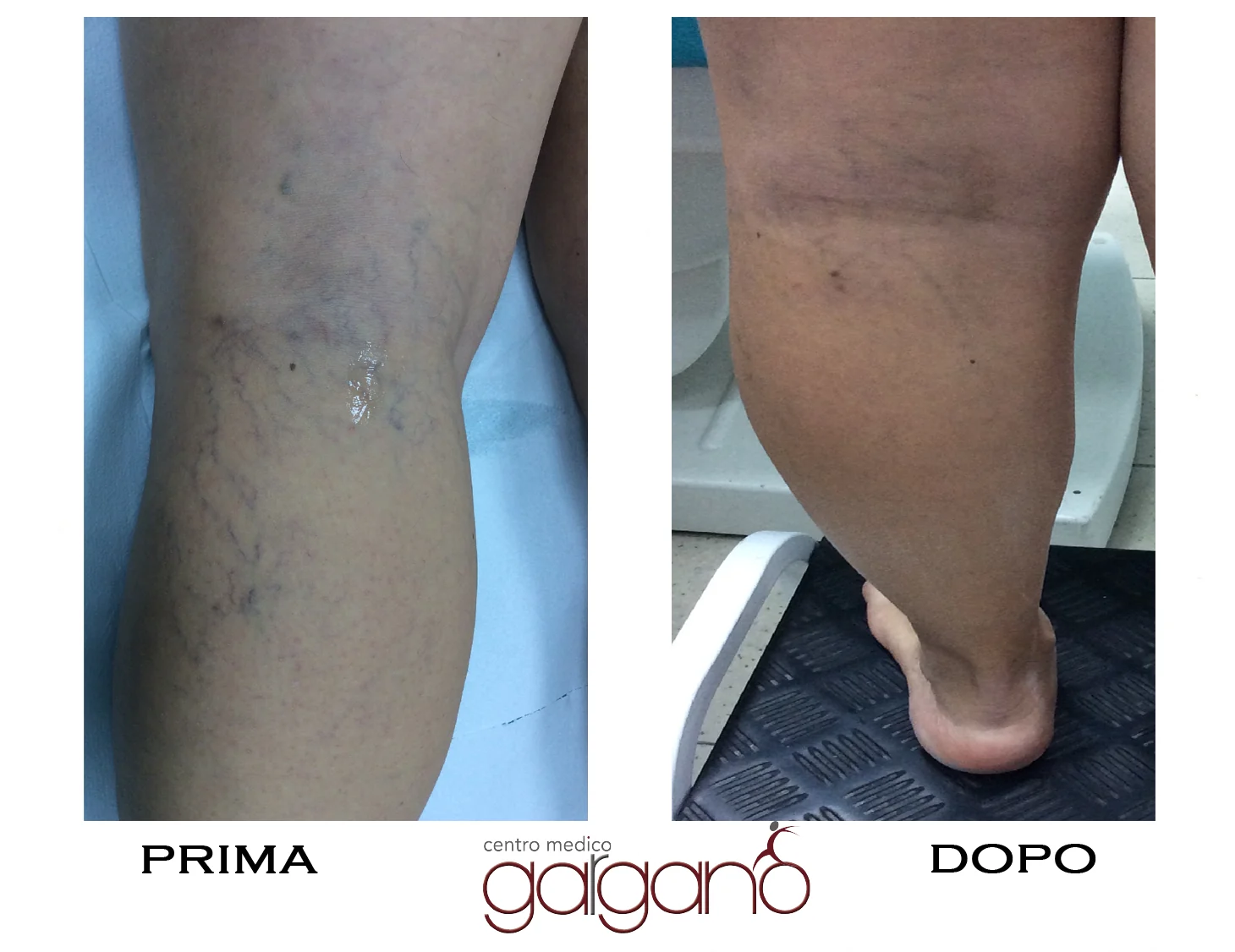
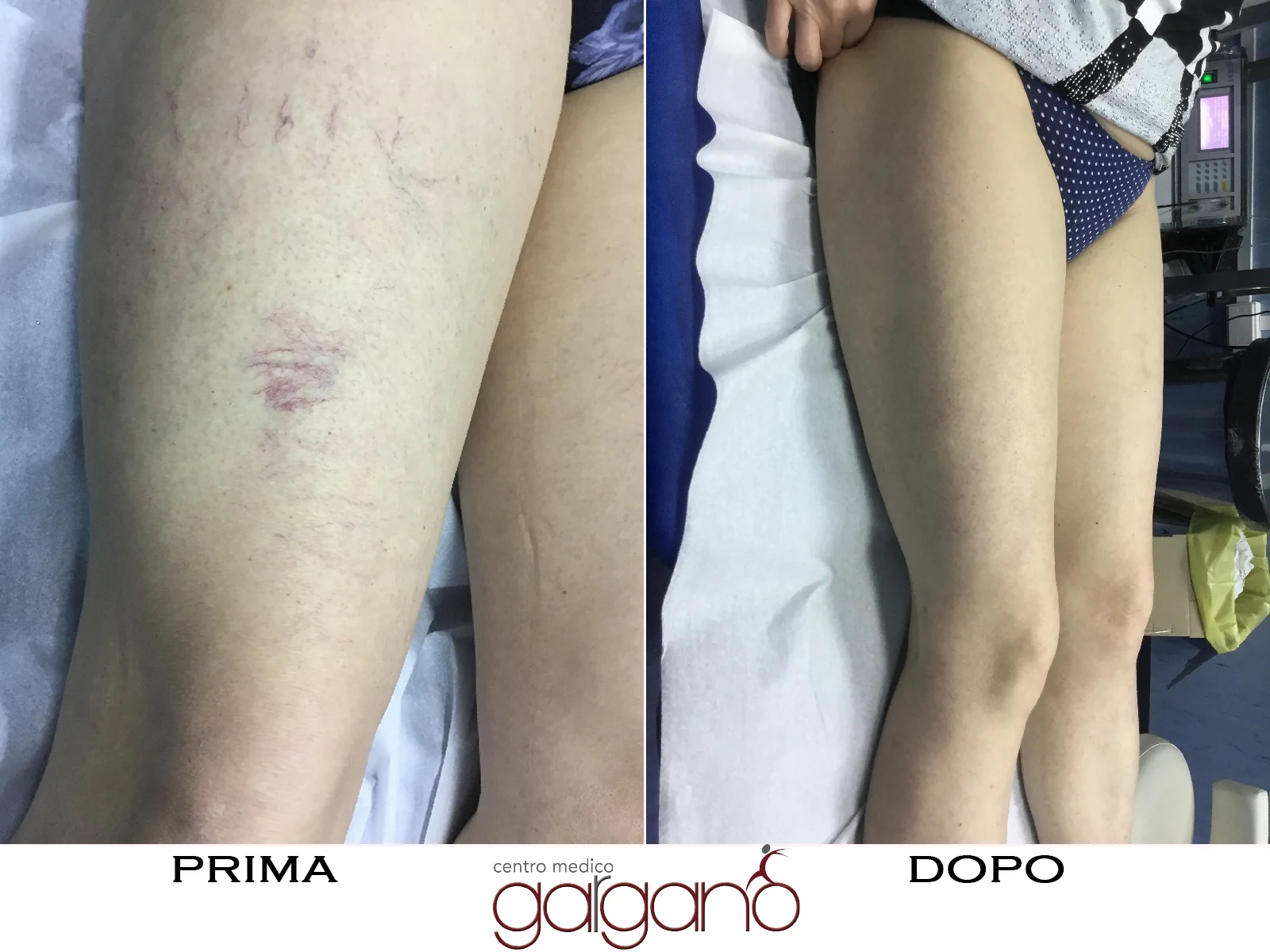
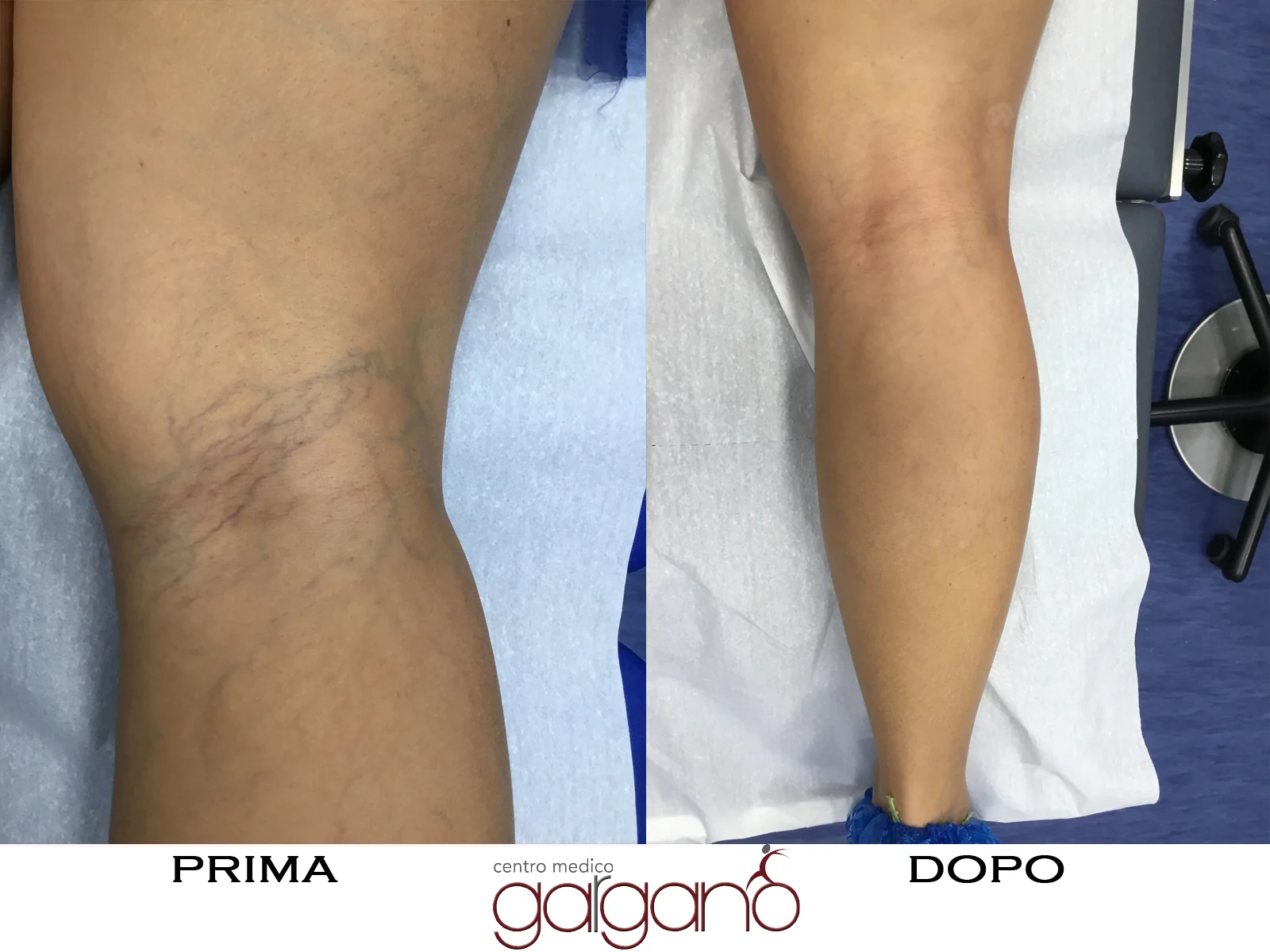
The photographs document individual cases. Position and lighting may differ between photographs; results vary from person to person.
Why an assessment before treatment is useful
Looking at the skin alone does not always explain the origin of spider veins. Some are isolated; others are supplied by reticular or feeder veins, or associated with venous reflux. For legs and thighs, treatment at our Centre is preceded by a consultation and vascular assessment with venous colour Doppler ultrasound, carried out personally by Dr Ciro Gargano to assess the venous condition and plan treatment.
Sclerotherapy and VeinGogh: how the technique is chosen
The technique of spider vein sclerotherapy, also called microsclerotherapy, involves injecting a sclerosant medicine as a liquid or foam; our Centre uses foam more frequently. Sclerotherapy can also treat reticular veins and some superficial varicose veins. VeinGogh instead uses thermocoagulation for very small superficial vessels on the face and selected areas of the legs and thighs, without injecting sclerosant medicines.
The choice depends on the location, diameter and depth of the vessels, skin characteristics and overall venous condition. VeinGogh does not treat feeder veins: when present and clinically relevant, these may require sclerotherapy or another specific treatment before or alongside treatment of the superficial spider veins. The doctor decides whether to use one method, combine methods or postpone treatment.
VeinGogh for spider veins: a closer look at the procedure
Dr Ciro Gargano demonstrates a stage of spider vein treatment with VeinGogh.
Original commentary by Dr Ciro Gargano in Italian. The text below is a summary of the video.
Video summary: The video illustrates a technique that differs from sclerotherapy. The treatment choice is determined through an individual assessment.
Book a consultation and colour duplex ultrasound for the legsWatch the video on its original platform
Facial thread veins in Naples: VeinGogh treatment
At Centro Medico Gargano in Naples, VeinGogh treatment is considered for fine, superficial facial thread veins. The device delivers microbursts of high-frequency electrical current through a very fine probe to produce targeted thermocoagulation of small blood vessels.
The consultation to assess removal of facial thread veins with VeinGogh is free and must be arranged by telephone with reception on 081 780 9641. This applies exclusively to this consultation; treatment and the consultation with colour duplex ultrasound of the leg veins are not included.
Discomfort may be felt during treatment, and redness may develop afterwards; there is also a risk of scarring. The number of sessions and the response to treatment vary from person to person. New thread veins may develop over time, and the doctor assesses whether further treatment is appropriate.
Further information: VeinGogh technology; the manufacturer’s patient information.
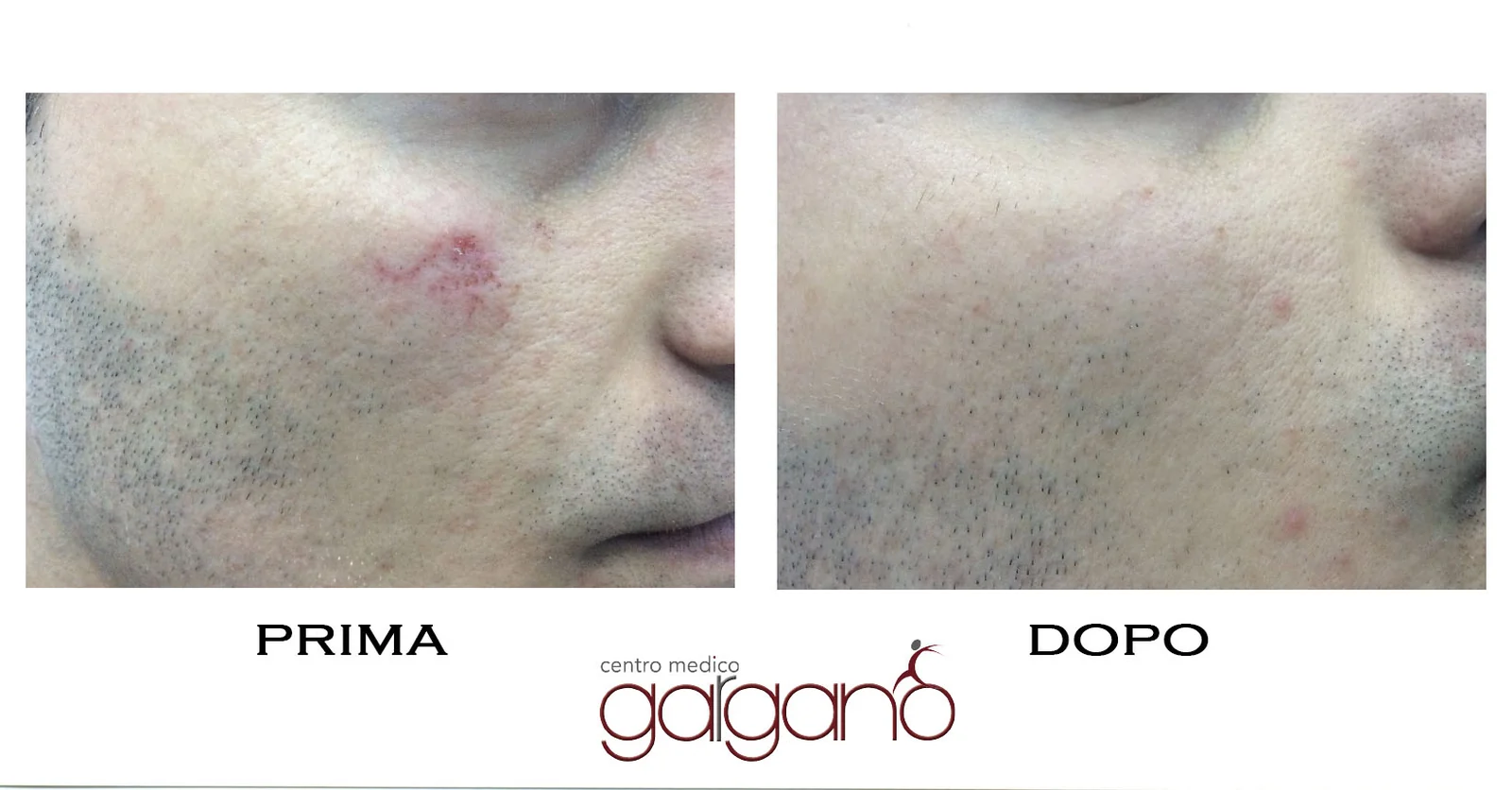
The photographs document individual cases. Position and lighting may differ between photographs; results vary from person to person.
How many sessions may be needed
The number of sessions cannot be reliably determined without an assessment. It may depend on the extent of the spider veins, the individual’s response, the type of vessel and the agreed goal. Improvement is generally gradual and may require follow-up or further sessions. Even after a good result, new spider veins may appear over time because treatment does not remove the individual’s predisposition.
Possible adverse effects and limitations
Temporary redness, small bruises, local tenderness, vessel hardening or pigmentation may occur after treatment. The frequency and type of adverse effects depend on the technique and the patient’s characteristics. Less common events should be discussed during informed consent. It is not appropriate to promise complete freedom from pain, complete removal in a single session or a permanent result.
The pathway at Centro Medico Gargano
Dr Ciro Gargano personally carries out the assessment and any subsequent treatment. For legs and thighs, the pathway begins with a consultation and colour duplex ultrasound scan of the leg veins; facial thread veins require a specific assessment of the area. Continuity between diagnosis and treatment is central to our approach to care. Find out more about phlebology in Naples.
Frequently asked questions about spider veins and telangiectasias
Answers to frequently asked questions about spider veins on the legs and face, EcoColorDoppler assessment, sclerotherapy and VeinGogh at Centro Medico Gargano in Naples.
Is a colour duplex ultrasound scan needed before treating leg spider veins?
Yes. At our Centre, treatment of spider veins on the legs and thighs, with either liquid or foam sclerotherapy or VeinGogh, requires a prior consultation and colour duplex ultrasound scan of the leg veins carried out personally by Dr Ciro Gargano. The same doctor assesses whether treatment is indicated and performs any subsequent treatment. This pathway applies to the lower limbs; facial thread veins require a specific assessment.
What are “broken capillaries”, and how do they differ from varicose veins?
Telangiectasias, commonly called spider veins or visible capillaries, are dilated small superficial blood vessels that appear as red, bluish or purple lines or branches. The expression “broken capillaries” is inaccurate: the vessels are dilated, rather than necessarily broken. Reticular veins are slightly larger and generally bluish; varicose veins involve larger veins that are often twisted and raised above the skin.
Why do spider veins appear on the legs?
Several factors contribute to the development of telangiectasias. These may include a family predisposition, hormonal changes, pregnancy, increasing age and excess weight. Spending many hours standing or sitting can also contribute to venous problems. In some cases, spider veins are associated with reticular veins or venous insufficiency, but this association is not always present.
Are visible spider veins only a cosmetic concern?
They are often mainly a cosmetic concern, particularly when they occur in isolation and cause no symptoms. However, they may be associated with other venous changes. Pain, heaviness, swelling, skin changes or bleeding warrant a medical assessment. These symptoms should not automatically be attributed to spider veins: their cause needs to be identified.
How is spider vein treatment chosen?
Sclerotherapy, or microsclerotherapy for spider veins, uses a liquid or foam sclerosant medicine; our Centre uses foam more frequently. VeinGogh uses thermocoagulation for very small superficial vessels on the face and selected areas of the legs and thighs. It does not treat feeder veins, which may require sclerotherapy or another specific procedure. The doctor chooses a method or combination of methods based on the assessment.
Is sclerotherapy painful? Does it require anaesthesia?
Sclerotherapy is a minimally invasive outpatient procedure, generally performed without anaesthesia. Very fine needles are used, and a prickling sensation or brief burning may be felt during the injection. Sensitivity varies from person to person. Any intense pain should be reported to the doctor immediately.
How many sessions are needed, and when do results become visible?
The number of sessions depends on the extent of the telangiectasias, the characteristics of the vessels and the individual response. Improvement is gradual: after sclerotherapy, the vessels may fade over the following weeks, while some areas need more time. The treatment plan is established during the consultation and reassessed at follow-up visits, without promising a fixed number of sessions.
What side effects can occur?
After sclerotherapy, small bruises, redness, local discomfort, hardening of the treated vessels and skin pigmentation may occur; pigmentation can sometimes persist. Matting, the appearance of a network of very fine spider veins, is also possible. Complications such as skin injury, significant allergic reactions or thrombosis are less common. Risks and contraindications are assessed before treatment.
When is the best time to treat spider veins, and what precautions are needed?
Cooler months can make sun protection and, when prescribed, wearing compression stockings more manageable. However, there is no single time of year that is right for everyone: scheduling depends on the technique and the patient’s habits. After the session, the doctor provides advice on sun exposure, physical activity and compression. Many everyday activities can generally be resumed within a short time.
Can spider veins reappear after treatment?
Treatment acts on existing vessels, but does not remove the predisposition to develop others. New telangiectasias may therefore appear over time, even after a good initial result. Any further treatment is assessed according to changes in the condition and the patient’s needs. A permanent result cannot be guaranteed.
Is a colour duplex ultrasound scan of the legs needed before VeinGogh treatment for facial thread veins?
No: a colour duplex ultrasound scan of the legs is not needed for small superficial facial thread veins to be treated with VeinGogh. At our Centre, however, a free preliminary consultation is always required to assess the vessels and any associated skin conditions. Arrange it by calling reception on 081 780 9641. The response and number of sessions vary between individuals; possible side effects, including the risk of small scars, are also discussed. Only this consultation is free, not the treatment.
What about visible veins on the face, hands, arms or other areas?
Visible facial veins (green or dark and sometimes palpable), as well as veins in the hands, arms or other areas, follow a different assessment pathway from small superficial facial thread veins. At our Centre, before treatment, we always perform a colour duplex ultrasound scan of the affected area using dedicated probes. You can book by calling reception on 081 780 9641 or through Book an appointment, selecting colour duplex ultrasound.
Can creams and natural remedies eliminate spider veins?
Creams, supplements and natural remedies have not been proven effective at eliminating existing telangiectasias. They should therefore not be presented as equivalent to procedures that act directly on the vessels. Before choosing a treatment, the characteristics of the spider veins and the condition of the skin should be assessed.
What can help limit the development of new spider veins?
Walking regularly, taking breaks from long periods of immobility and maintaining an appropriate weight support venous return. Graduated compression stockings can improve certain symptoms when recommended by the doctor, but they do not eliminate existing spider veins or guarantee that new ones will not appear. No preventive measure completely removes an individual’s predisposition.
Reference sources
The general information is consistent with the ESVS guidelines on chronic venous disease of the lower limbs and NICE guidance on the diagnosis and management of varicose veins. Clinical decisions remain individual and are made during the consultation.
FAQ references: the Cochrane review of treatments for telangiectasias and patient information from the American Academy of Dermatology and the American Society for Dermatologic Surgery.
Leg spider veins: choose your pathway
Before treating spider veins on the legs and thighs, our Centre requires a consultation and venous colour duplex ultrasound scan performed by Dr Ciro Gargano, the same doctor who carries out the treatment. If you have already had these and treatment has been recommended, you can book the agreed session.
Treatment session for veins and spider veins
One service for microsclerotherapy of spider veins, sclerotherapy of varicose veins or VeinGogh when indicated. The doctor selects the method after assessment.
The consultation to assess removal of facial thread veins with VeinGogh is free and must be arranged by telephone with reception on 081 780 9641. This applies exclusively to this consultation; treatment and the consultation with colour duplex ultrasound of the leg veins are not included. If you have already agreed treatment with the doctor, you can book your session using the same treatment option.
